
Chiropractic Care
and the Importance of Touch
Asking AI/SI this question (10/29/26):
Who was the most intelligent person in history?
The response lists six contenders, noting:
“There is no single consensus on who was the smartest person in history because intelligence takes many forms—such as mathematical genius, polymathic creation, or theoretical physics. However, several historical and modern figures are frequently cited as the top contenders.”
Of the six contenders listed, none are biologists (with the partial exception of Leonardo da Vinci who had an interest in anatomy). The others were mathematicians, physicists, and polymaths (an individual whose knowledge, skills, and expertise span a wide and diverse range of multiple distinct subjects rather than being confined to a single specialty).
One of the contenders is Sir Issac Newton. AI/SI states:
“Often ranked by scientists and historians as one of the most brilliant polymaths ever, he formulated the laws of motion and universal gravitation and co-invented calculus.”
Newton was from England, born in 1643 and died at age 84 in 1726. Newton is best known for his book Mathematical Principles of Natural Philosophy, which was published in 1687. In this book, Newton formulated his Three Laws of Motion, which are today the foundation of classical mechanics:
First Law (Law of Inertia)
An object at rest stays at rest, and an object in motion stays in motion at a constant speed in a straight line, unless an unbalanced external force acts on it.
Inertia is an object’s natural tendency to resist any change in its state of motion.
Second Law (Law of Force and Acceleration)
Force = Mass X Acceleration
Or
Mass = Force/Acceleration
Or
Acceleration = Force/Mass
Third Law (Law of Action and Reaction)
Forces always exist in equal and opposite pairs; when one object exerts a force on another, the second exerts an equal and opposite force back.
•••••
Chiropractic adjustments are specific line-of-drive manipulations. During adjustments, chiropractors are using all three of Newton’s Laws of motion:
First Law (Law of Inertia)
The chiropractic subluxation occurs when a joint(s) (primarily a spinal vertebrae) becomes “stuck” in an abnormal position or have an impaired ability to move normally with respect to the adjacent joint(s). Applying Newton’s First Law, this subluxation cannot self correct. Correction of the subluxation requires the application of an external force, known as the chiropractic adjustment. Following the law, correction is not possible without the adjustment.
Second Law (Law of Force and Acceleration)
The chiropractic adjustment requires the application of a force, and Force = Mass X Acceleration. During the chiropractic adjustment, the mass is typically the tip or another part of a finger or thumb.
Velocity is the changing of position over time. We are all familiar with a vehicle traveling 60 miles per hour; this means that in a one-hour period of time, the vehicle’s position would change 60 miles.
Acceleration is the rate of the change in velocity with respects to time. We are all familiar with the driver of a stopped vehicle stepping on the gas to get up to speed, let’s say 60 miles per hour; this is increasing speed, which is acceleration. The point is that in the applied force (adjustment) provided by chiropractors, acceleration is a change in velocity, going from zero to something.
Traditional chiropractic adjustments are described as being high velocity low amplitude (HVLA):
High Velocity means High Acceleration.
Low Amplitude means that the movement of the joint is very small, typically only a few millimeters (1). Importantly, this low amplitude movement does not exceed the limits of anatomic integrity (by the joint capsules), meaning it does not injure any soft tissues (1).
Third Law (Law of Action and Reaction)
The application of force by chiropractors involves touch:
When chiropractors apply a force to adjust a subluxation, the patient is exerting an equal and opposite force back into the chiropractor. Both the patient and the chiropractor experience touch.
Touch is also an important component of standard chiropractic diagnostics. This incudes activities such as putting joints through ranges-of-motion, performing orthopedic/neurological tests, and assessing changes in tissue consistencies, such as hypertonicity, spasm, swelling, temperature, etc.
Touch is also required in performing segmental positional and motion diagnostics in order to assess the presence and direction of the subluxation.
Touch is an ever-present integral part of all aspects of chiropractic clinical practice.
Touch
Nerves create electrical signals. These electrical signals travel in opposite directions:
- Travel to the brain. These nerves are termed sensory or afferent.
- Travel away from the brain. These nerves are termed motor or efferent.
The human body has many more sensory nerves (about 10 million) than motor nerves (about 500,000); in other words, the ratio is about 20:1 (2).
Touch creates a sensory electrical signal that is sent to the brain. All touch sends a sensory electrical signal to the brain where the signal is perceived, interpreted, and elicits a motor nerve response.
In the brain, there is a distorted visual map of the human body that is laid across the brain’s cerebral cortex. The touch electrical signal is sent to this sensory homunculus. This is how the brain knows what part of the body is being touched:
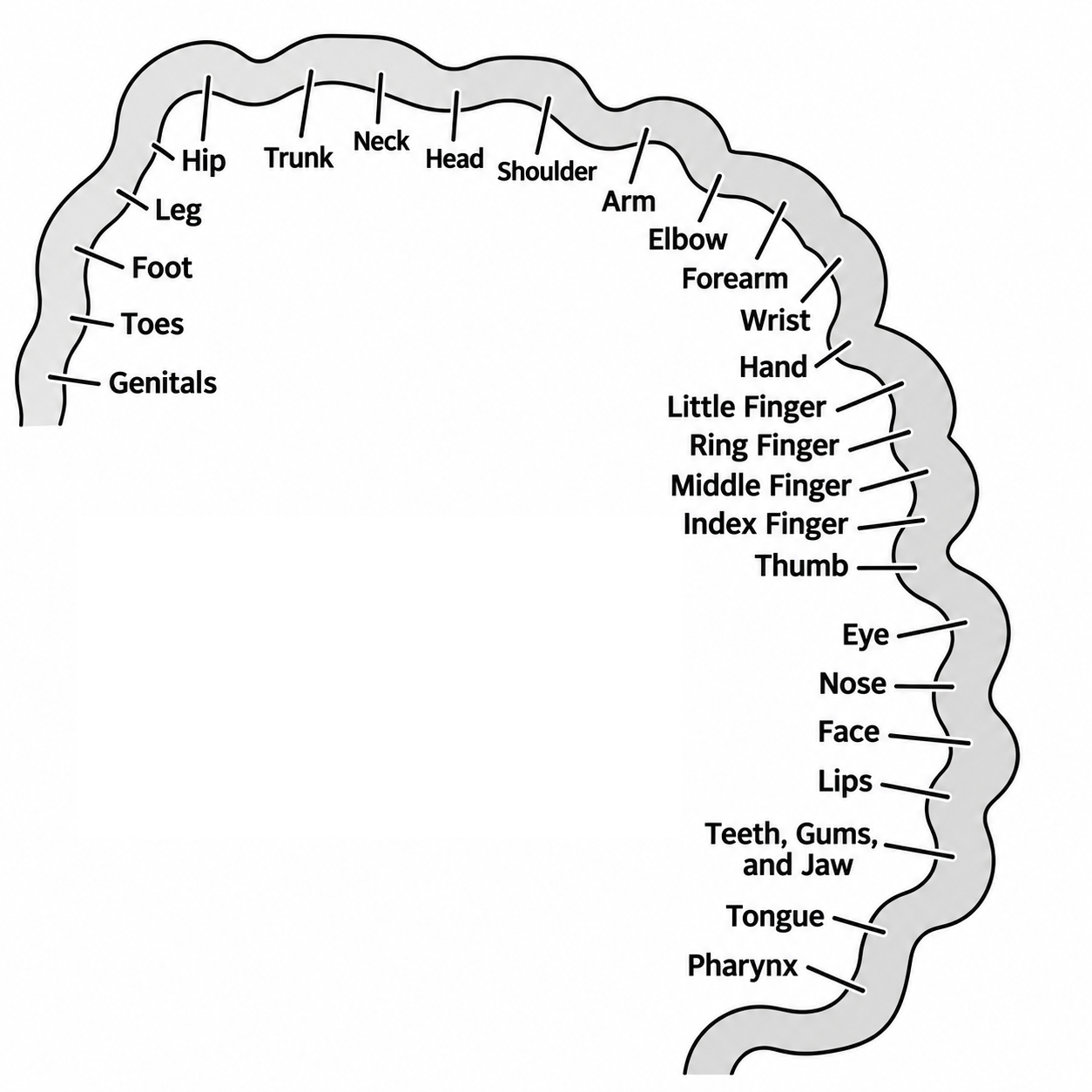
Observe that the lips, fingers, and tongue have larger areas of homunculus representation as compared to other body regions.
Perhaps the earliest landmark publication on touch was published by British anthropologist Ashley Montagu (1905-1999) in 1953. It was published in the journal Texas Reports on Biology and Medicine, and titled (3):
The Sensory Influences of the Skin
In this paper, Montagu explains how lack of skin contact and tactile stimulation in human infants severely affects their subsequent emotional, psychological, and behavioral development. Montagu notes that the skin is much more than a passive physical boundary. It is a vital primary sensory organ that plays a central role in human bonding and growth.
Eighteen years later (1971), Montagu published a 406-page book titled (4):
Touching: The Human Significance of the Skin
Here, Montagu argues that tactile interaction is a fundamental biological need as critical to human survival and development as food, water, and shelter. AI/SI reviews of this book note:
- Touch is The Mother of Senses.
- Skin is our oldest, largest, and most sensitive organ.
- In embryonic development, the sense of touch is the very first sensory system to become functional.
- Touch and other external, physical sensations directly build and alter internal psychological, mental, and behavioral structures.
- In mammals, maternal licking and stroking are not just affectionate; they jumpstart the newborn’s respiratory, gastrointestinal, and excretory systems.
- Tactile experience reinforces the immune system and regulates metabolism.
- A lack of healthy touch during infancy leads to a breakdown in behavioral health often manifesting later in life as chronic anxiety, fear, aggression, depression, or an inability to form deep emotional attachments.
- Human touch is a primal biological and psychological necessity that regulates the nervous system, lowers stress, and builds social bonds.
- Touching stimulates the release of oxytocin, a hormone that lowers blood pressure, slows the heart rate, and creates feelings of trust and emotional security.
- Regular touching increases natural killer cells and lymphocytes, helping the body fight off viruses and infections.
- Touch significantly reduces symptoms of chronic pain, depression, and anxiety.
Specific important points from Montagu’s book include (4):
“Next to the brain, the skin is the most important of all of our organ systems.”
“The sense most closely associated with the skin, the sense of touch, is the earliest to develop in the human embryo.”
“As a sensory system the skin is the most important organ system of the body.”
“A human being can spend his life blind and deaf and completely lacking the senses of smell and taste, but [s]he cannot survive at all without the functions performed by the skin.”
“The need for tactile stimulation must be added to the repertoire of basic needs in all vertebrates.”
“The evidence points unequivocally to the fact that no organism can survive very long without externally originating cutaneous stimulation.”
•••••
In 2006, reporter Roger Dobson published an article in the Independent titled (5):
How the Power of Touch Reduces Pain and Even Fights Disease
The author notes:
- “Touch, a key component of traditional healing, is being increasingly studied in mainstream medicine, with some trials showing symptom benefits in a number of areas, from asthma and high blood pressure to migraine and childhood diabetes. Other research findings hint that not only does touch lower stress levels, but that it can boost the immune system and halt or slow the progress of disease.”
- “The Touch Research Institute at the University of Miami School of Medicine says it has carried out more than 100 studies into touch and found evidence of significant effects, including faster growth in premature babies, reduced pain, decreased autoimmune disease symptoms, lowered glucose levels in children with diabetes, and improved immune systems in people with cancer.”
- “Cincinnati Children’s Hospital is one of a number of leading health centers in the US that now uses healing touch therapy. Research has demonstrated that patients who receive healing touch experience accelerated wound healing and relaxation, pain relief, and general comfort.”
- “According to a Stanford University report, several studies are showing significant benefits in wound healing, pain and anxiety. It says touch therapy may also have positive effects on fracture healing and arthritis.”
•••••
In 2015, David Linden, PhD, authored a book titled (6):
Touch
The Science of Hand, Heart, and Mind
Dr. Linden is a professor of neuroscience at Johns Hopkins University. In his book, Dr. Linden makes these points:
“Touch is not optional for human development. We have the longest childhoods of any animal—there is no other creature whose five-year-old offspring cannot live independently. If our long childhoods are not filled with touch, particularly loving, interpersonal touch, the consequences are dramatic.”
“Doctors who touch their patients are rated as more caring, and their patients have reduced stress-hormone levels and better medical outcomes.”
“In humans, touch is the first sense to become functional in utero, at about eight weeks’ gestation.”
“Touch information is subconsciously combined with inputs from vision, hearing, and proprioception (a sense of where our bodies are located in space that comes from nerve endings in our muscles and joints) to rise to rich, nuanced perception.”
“Mechanoreceptors ... have the common property of converting mechanical energy into electrical signals.”
Enhanced touch produces expansion of the sensory homunculus map of the brain. Immobilization shrinks the sensory homunculus map of the brain by about 50% after only 7 days.
“Interpersonal touch not only has a special role in early human development but continues to be crucial across the span of human social life. Promoting trust and cooperation and thereby deeply influencing our perception of others.”
“All these discoveries about touch are significant, for they help us understand a central aspect of our human experience.”
•••••
In 2021, Nicole McNichols, PhD, published an article in the journal Psychology Today titled (7):
The Vital Importance of Human Touch:
The Science of Human Touch and What to do if You’re Feeling Deprived
Dr. McNichols is an associate professor of psychology at the University of Washington. Key points from her article include:
- “The need for human touch is one of our most basic, primal needs.”
- “The research demonstrating the need for human touch is vast.”
- “Touch deprivation is correlated with negative health outcomes such as anxiety, depression, and immune system disorders.”
- “From a developmental standpoint, infants literally cannot survive without human touch.”
- “Food may be necessary for survival, but touch is what sustains us.”
- “Research has uncovered an astonishing number of poor health outcomes that result when we are deprived of touch.”
- “The correlation between anxiety, depression, and stress and touch is large and inversely related.”
- “Touch calms our nervous center and slows down our heartbeat.”
- The effects of touch extend to our basic neural circuitry.
- “Even our immune response seems to be somewhat governed by touch, with the finding that those who are deprived of human touch are more likely to suffer from immune system diseases. It’s ironic that during a highly contagious pandemic [during the COVID-19 lockdowns of 2020 and 2021] where our immune systems are being the most stressed, we are being deprived of something (human touch) that is so essential to its function.”
•••••
Also from 2021, an article was published in the Journal of Bone and Joint Surgery, American, titled (8):
What’s Important: The Power of Touch
The authors are from Florida International University Herbert Wertheim College of Medicine in Miami, and The Ohio State University Wexner Medical Center, in Columbus. These authors note:
- “As one of the foundational skills in musculoskeletal medicine and a key aspect of the physical examination, palpation can provide health- care professionals with numerous pieces of information to help guide the treatment plan.”
- “The impact of palpation and touch goes far deeper than just to gather information: it helps to form a bond between provider and patient.”
- “The therapeutic and healing properties of touch can serve to comfort, reduce anxiety, and reduce pain.”
- “The overall effect of touch is powerful and should not be ignored.”
- “Through touch, we are able to bond with our patients while also obtaining the information necessary to provide care that respects the patient’s wishes.”
- “We should never neglect the fundamentals of musculoskeletal physical examination and that it is important to be comfortable utilizing our hands in patient care.”
•••••
In 2025, physical therapist (DPT) Lindsay Paulsen published an article in Stanford Medicine titled (9):
Hands-On Healing:
The Evidence Behind Therapeutic Touch
Dr. Paulson, often referencing recent research, notes:
- “We aim to remind our fellow health care providers why touch, in its various forms, plays such a critical role in healing.”
- “The human hand has incredible power as a diagnostic tool, but it also has important emotional and physical benefits for patients.”
- “Touch benefits both physical and mental well-being.”
- “Touch interventions reduce feelings of depression, anxiety, and physical pain.”
- “Hands are far more profound than we usually realize: They are our primary language of compassion, and a primary means for spreading compassion.”
- “The simple yet profound act of human touch remains one of our most powerful tools for healing and it’s one that we must not lose sight of in our daily practice.”
•••••
A Chiropractic Connection
All of the concepts and citations above have significant importance to the chiropractic profession and to their patients. Chiropractic literally means to practice with the hands, using touch. Particularly relevant and important are the concepts of how touch reduces pain, accelerates healing, and neurologically integrates with other proprioceptive components in the brain.
Being a chiropractor is a remarkably satisfying vocation. Chiropractors help people suffering from pain by adjusting subluxations with their hands; and both the patient and the chiropractor benefit from the other wonders of touch.
An Ending Story
In her 1990 book, Mutant Message Down Under, Marlo Morgan, a middle-aged, white, American woman chronicles her journey with a group of 62 desert Aborigines across the continent of Australia (10). Morgan chronicled a cultural habit, estimated to be millennia old, at the end of each day’s nomadic journey: members of the group using touch to deliver spinal manipulation to each other. Marlo Morgan notes (10):
“Evenings were a real joy with the tribal people. They told stories, sang, danced, played games, had heart to heart chats. This was a real time for sharing. There was always some activity while we waited for the food to be prepared. They did a lot of massaging and rubbing of each other’s shoulders, backs, even their scalps. I saw them manipulating necks and spines.”
REFERENCES
- Kirkaldy-Willis WH; Managing Low Back Pain; Second Edition; Churchill Livingstone; 1988.
- https://my.clevelandclinic.org/health/body/22584-nerves; Updated March 22, 2022; Accessed November 1, 2026.
- Montagu A; The Sensory Influences of the Skin; Texas Reports on Biology and Medicine; Vol. 11; No. 2; pp. 291–301.
- Montagu A; Touching: The Human Significance of the Skin; Harper & Row; 1971.
- Dobson R; How the Power of Touch Reduces Pain and Even Fights Disease; Independent; October 9, 2026.
- Linden D; Touch: The Science of Hand, Heart, and Mind; Penguin Press; 2015.
- McNichols NK; The Vital Importance of Human Touch: The Science of Human Touch and What to do if You’re Feeling Deprived; Psychology Today; August 3, 2021.
- Khan IA, Carmen E. Quatman CE; What’s Important: The Power of Touch; Journal of Bone and Joint Surgery, American; May 19, 2021; Vol. 103; No. 10; pp. 947–948.
- Paulsen L; Hands-On Healing: The Evidence Behind Therapeutic Touch; Stanford Medicine; July 3, 2025.
- Morgan M; Mutant Message Down Under; 1990.
“Authored by Dan Murphy, D.C. Published by ChiroTrust® – This publication is not meant to offer treatment advice or protocols. Cited material is not necessarily the opinion of the author or publisher.”
